The statewide rule and where cities differ
Arizona law requires an enclosure around qualifying pools: water at least 18 inches deep at any point, wider than 8 feet, and intended for swimming. The enclosure generally must be at least 5 feet high, have openings smaller than a 4-inch sphere, have no climbable exterior features, and sit at least 20 inches from the water's edge.[5]
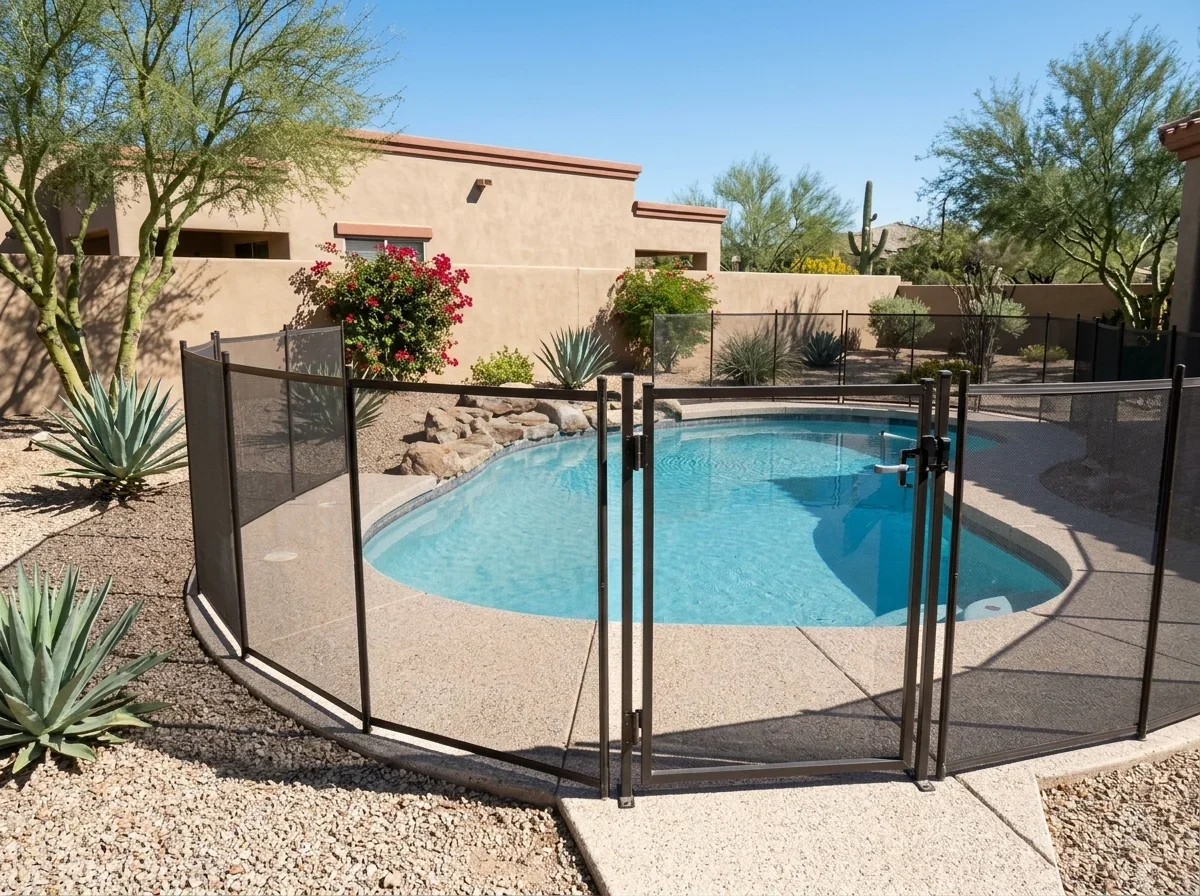
Cities then adopt the International Swimming Pool and Spa Code with local amendments. That is why the same pool can face different gate, latch and door rules depending on the address.
Pool barrier rules by city
The table below summarizes what each city's own document says. A blank means the document does not state it, so it is not listed here.
| City | Barrier height | Gates | Latch height | House wall as barrier |
|---|---|---|---|---|
| Phoenix | 5 feet, measured from the exterior side[1] | Self-closing, self-latching[1] | 54 inches minimum[1] | Conditional |
| Mesa | 60 inches minimum[2] | Self-closing, self-latching, open outward[2] | Latch release 54 inches minimum above grade[2] | Conditional |
| Maricopa | 5 feet, measured from the exterior side[3] | Self-closing, self-latching | See note below | Conditional |
| Lake Havasu City | 5-foot permanent fence[4] | Self-closing, self-latching, open outward[4] | Not stated here | Conditional |
Information in the table was checked October 2026.
City-by-city details
Phoenix
Phoenix cites the 2024 International Swimming Pool and Spa Code with City of Phoenix amendments, section 305.3.2. Its document says the fence "must be five feet (5') high measured from the exterior side of the fence" and that gates "must be self-closing and self-latching and able to accommodate a lock." The latch must be 54 inches minimum above ground.[1]
54 inches
minimum latch height in Phoenix
If the house wall forms part of the barrier, Phoenix says all doors must be self-closing and self-latching and must swing outward from the pool area.[1]
For other Phoenix jobs, see the Phoenix permit page.
Mesa
Mesa's checklist sets barrier height at 60 inches minimum (M-ISPSC 305.2.1 Exception 1). Pedestrian gates must self-close, self-latch and open outward away from the pool. The latch release must be at least 54 inches above grade.[2]
Where the dwelling wall is part of the barrier, Mesa requires one of several measures, including a key-operated powered safety cover (ASTM F1346) or self-closing, self-latching doors (M-ISPSC 305.4).[2]
More local rules are on the Mesa permit page.
Maricopa
The City of Maricopa follows its own Pool & Spa Barrier Regulations and Arizona Statute 36-1681. Walls and fences must be at least 5 feet high, measured from the exterior side.[3]
Sliding doors that are part of the barrier must be self-closing and self-latching, or have an alarm that complies with UL 2017. Other doors opening into the barrier must either be self-closing and self-latching with a handle at least 54 inches above the finished floor, or have a UL 2017 alarm.[3]
The 54-inch figure applies to window latches and door handles, not to gates. The city's page gives no separate gate latch height.[3]
Lake Havasu City
Lake Havasu City's pool enclosure pamphlet requires a pool to be entirely enclosed by a permanent fence at least 5 feet high. Gates must be self-closing, self-latching and open outward from the pool.[4]
If a residence or other living structure forms part of the enclosure, the pamphlet calls for a separate wall, fence or barrier a minimum of 4 feet high.[4]
How house walls change the picture
All four documents allow a house wall to serve as part of the barrier only with extra measures, which is why the table marks it conditional. Phoenix focuses on door hardware and swing direction. Mesa offers a choice of measures. Maricopa allows alarms in some cases. Lake Havasu City asks for a separate barrier.[1][2][3][4]
Side by side
House wall measures
Door-based measures
- Phoenix: self-closing, self-latching doors that swing outward
- Mesa: powered safety cover or self-latching doors
- Maricopa: UL 2017 alarm in some cases
Separate barrier
- Lake Havasu City: wall, fence or barrier at least 4 feet high
Cities where you should check with the city
The following cities are not confirmed on this page, so check with the city's building department for barrier height, gate, latch and house-wall rules: Chandler, Gilbert, Scottsdale, Glendale, Tempe, Peoria, Surprise, Goodyear, Avondale, Buckeye, Queen Creek, San Tan Valley, Tucson, Flagstaff, Yuma and Prescott.
Two have city pages here with permit information: Scottsdale and Tucson.
The statewide baseline in A.R.S. 36-1681 still applies to qualifying pools, but the city has the final word on local amendments.[5]
Care settings use a similar standard
If a child under age seven receives care in your home, the Arizona Department of Child Safety guidance asks for a barrier at least 5 feet high with openings under 4 inches. Gates must be self-closing and self-latching, open away from the pool, and latches must be at least 54 inches high or secured as specified.[6]
Before you build or repair a barrier
Check the permit status for your job first. The permit rules by city cover related jobs such as block walls.
A block wall permit may matter if a wall forms part of your barrier.
Ask the city whether the barrier needs inspection before you fill the pool. Verify any contractor with the Arizona Registrar of Contractors license look-up before you hire, and read the license check guide for how to use it.
Pro tip
Ask the city building department for its written barrier requirements before you buy a gate or latch, since rules differ by address.
For broader context, see pools in Arizona.
Quick answers
How high must an Arizona pool barrier be?
The statewide enclosure generally must be at least 5 feet high, and the cities covered here also use 5 feet or 60 inches.
How high must a pool gate latch be?
Phoenix requires 54 inches minimum, and Mesa requires the latch release at least 54 inches above grade. Lake Havasu City's pamphlet does not state it here.
Can a house wall be part of the pool barrier?
Only with extra measures, such as self-closing, self-latching doors, an alarm in some cases, or a separate barrier.
Sources
- City of Phoenix. "Phoenix: pool barrier requirements." https://www.phoenix.gov/content/dam/phoenix/pddsite/documents/trt/external/dsd_trt_pdf_00144.pdf. Accessed October 21, 2026.
- City of Mesa. "Mesa: pool barrier requirements." https://www.mesaaz.gov/files/assets/public/v/3/business-development/devsvcs/checklists/residential-poolspa.pdf. Accessed October 21, 2026.
- City of Maricopa. "Maricopa: pool barrier requirements." https://www.maricopa-az.gov/files/assets/city/v/1/development-services/documents/handouts-guidelines-resources/swimming-pool-spa-submittal-requirements.pdf. Accessed October 21, 2026.
- City of Lake Havasu City. "Lake Havasu City: pool barrier requirements." https://www.lhcaz.gov/DocumentCenter/View/1251/Pool-Enclosure-Pamphlet-PDF. Accessed October 21, 2026.
- Arizona Legislature. "36-1681 - Pool enclosures; requirements; exceptions." https://www.azleg.gov/ars/36/01681.htm. Accessed October 21, 2026.
- Arizona Department of Child Safety. "CSO-1601." https://dcs.az.gov/sites/default/files/CSO-1601.pdf. Accessed October 21, 2026.