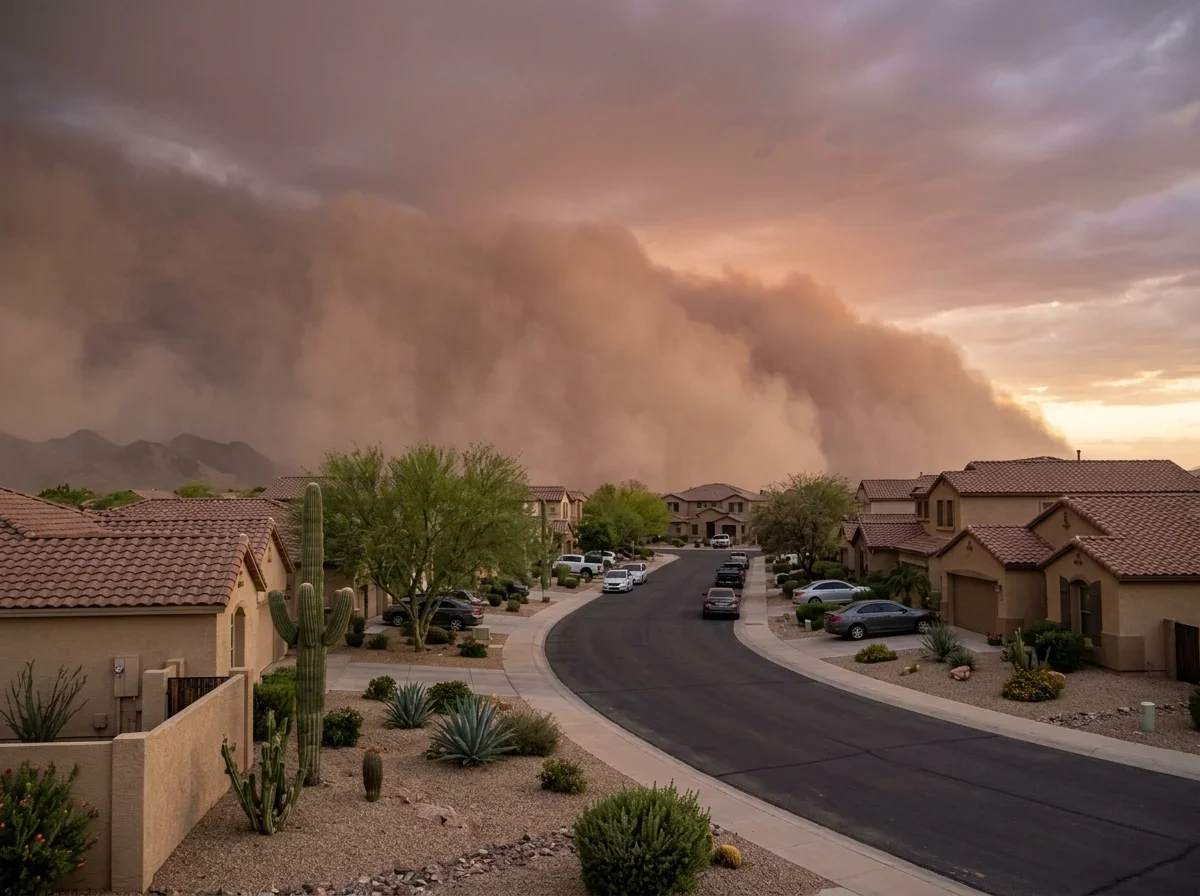
A haboob is a wall of dust, and it arrives fast
In Arizona, haboobs are generated by thunderstorms and downbursts. They typically occur across the central and western deserts during the summertime monsoon season.[4] The mechanism is simple.
When rain evaporates into hot, dry desert air, the air cools and accelerates downward as a microburst. Gusts striking the desert and valley floors can create haboobs that travel dozens of miles and cut visibility to near zero.[5]
Dust storm vs. haboob
"Dust storm" is the broader term. The National Weather Service defines a dust storm event as blowing dust with visibility reduced to one-half mile or less and an accompanying wind shift or increase.[4]
A haboob is a dust storm produced by thunderstorm outflow.
NWS Phoenix says haboobs can drop visibility from unrestricted to less than one-quarter mile faster than any other meteorological event.[7] That speed is why there is rarely time to prepare once you see the wall.
| Term | What causes it | Visibility |
|---|---|---|
| Dust storm | Blowing dust with a wind shift or increase | One-half mile or less |
| Haboob | Thunderstorm outflow | Can fall below one-quarter mile |
When Arizona dust storms hit
Haboobs are tied to the monsoon. They belong to the summer thunderstorm season rather than to a single date on the calendar.[4] NWS Phoenix describes violent dust storms as routine during the Arizona monsoon.[7]
For the season's dates and a full prep list, see monsoon season dates and home prep.
For climate context only, and not as a measure of how often dust storms occur: at the Maricopa County station (Phoenix Sky Harbor), the 1991-2020 normal July high is 106.5 F. July through September rain normals add up to 2.41 inches.[3]
Hot, dry air and brief, intense storms are the setting.
What dust does to AC units, pools, roofs and solar panels
Treat this as a post-storm checklist rather than a damage forecast.
Fine dust and wind-blown debris land on every exterior system. Each one deserves a look once the air clears.
- AC and HVAC: Check the outdoor unit for accumulated debris and inspect or replace the filter. Details are on the HVAC hub.
- Pools: Dust and debris end up in the water and the skimmer. See the pools hub for barrier rules and summer care.
- Roofs: Wind can expose weak points, so look for displaced material and damaged screens. The roofing hub covers permits and licensing.
- Solar panels: Check the array for settled dust and loose debris. The solar hub covers permits and licensing.
Photograph any damage before you clean or repair anything. Then review your policy, since coverage depends on the specific policy and cause of loss.
Before hiring anyone, check the contractor's license.
Staying safe when one hits
The biggest danger is on the road.
Strong monsoon downbursts can create dense blowing dust that reduces visibility to near zero within seconds.[6]
Arizona's emergency information network gives drivers these steps:[6]
- Pull off the roadway and park.
- Turn off the vehicle's lights.
- Release the brake pedal.
- Stay buckled inside the vehicle.
- Wait for the storm to pass.
At home, go inside when you see the dust front approaching. Close windows and exterior doors, and secure patio furniture and other loose items before the wind arrives.
Decide
What to do when the dust front arrives
Are you driving?
If Yes
then: Pull off, park, lights off, brake released, stay buckled
If No
then: Go inside, close windows and doors, secure loose items
For official guidance, read the NWS pages on wind and dust storm safety[1] and the NWS Phoenix dust storm and monsoon page.[2]
Rely on those alerts over social media photos for current conditions.
Sources
- National Weather Service. "National Weather Service: wind and dust storm safety." https://www.weather.gov/safety/wind-dust-storm. Accessed October 21, 2026.
- National Weather Service. "NWS Phoenix dust storm and monsoon safety." https://www.weather.gov/psr/MonsoonSafety. Accessed October 21, 2026.
- NOAA National Centers for Environmental Information. "NOAA 1991-2020 Climate Normals, Phoenix Sky Harbor International Airport (monthly normals)." https://www.ncei.noaa.gov/access/services/data/v1?includeStationName=1&format=csv&stations=USW00023183&dataset=normals-monthly-1991-2020&dataTypes=MLY-TMAX-NORMAL,MLY-PRCP-NORMAL. Accessed October 21, 2026.
- National Weather Service Western Region. "Blowing Dust and Dust Storms: NOAA Technical Memorandum NWS-WR 290." https://www.weather.gov/media/wrh/online_publications/TMs/TM-290.pdf. Accessed October 21, 2026.
- National Weather Service Tucson. "Monsoon Information Page." https://www.weather.gov/twc/Monsooninfo. Accessed October 21, 2026.
- Arizona Emergency Information Network. "Monsoon Awareness." https://ein.az.gov/monsoon-awareness-0. Accessed October 21, 2026.
- National Weather Service Phoenix. "Did You Know?." https://www.weather.gov/psr/didyouknow. Accessed October 21, 2026.