Start with safety and the equipment
Stay out of the pool and away from open areas until the threatening weather has passed. The National Weather Service advises people to get away from open areas, including swimming pools, during threatening weather.[2]
Arizona dust storms can cut visibility to one-quarter mile or less, so a storm can arrive faster than it looks.[2]
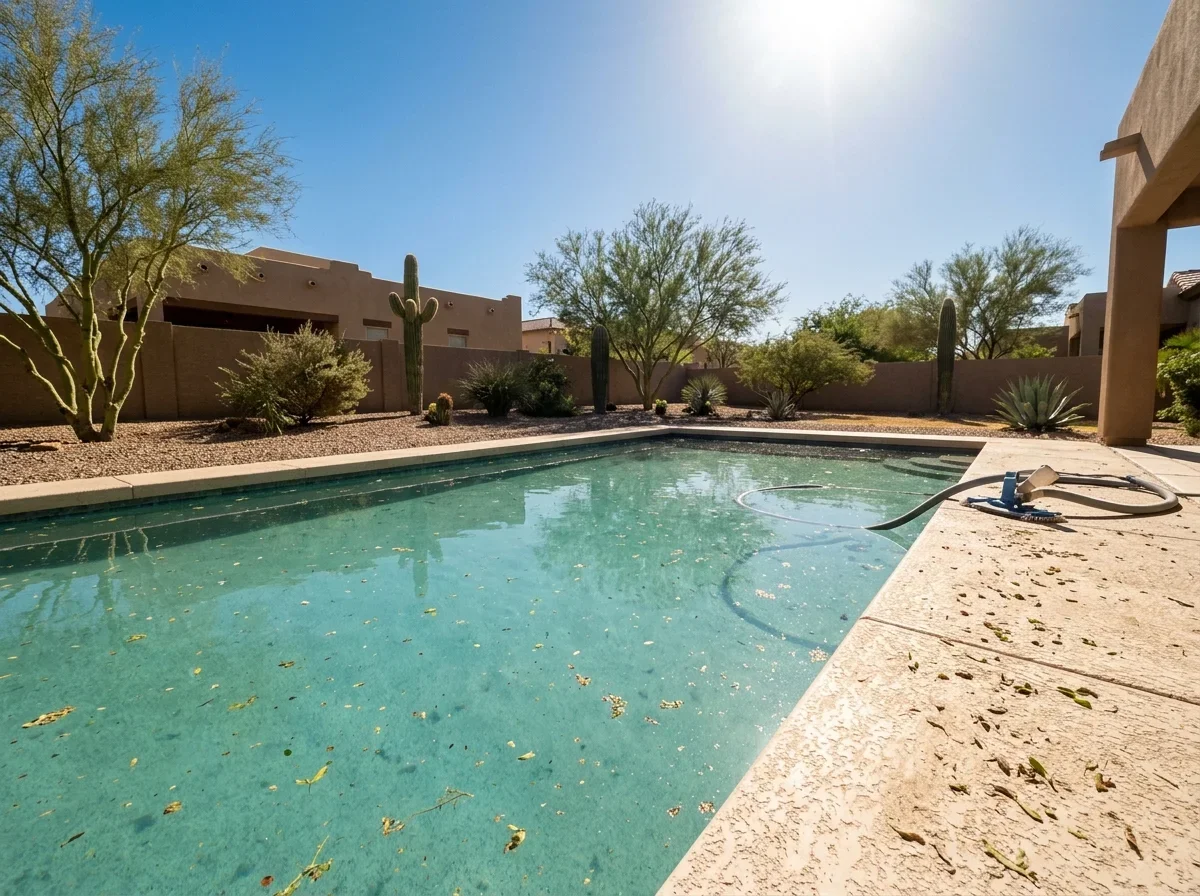
The monsoon months covered here are July through September. The July normal high at the station for Maricopa County is 106.5 F, and July through September rain normals add up to 2.41 inches there.[1] For how the storms behave around a house, see our guide to haboobs and your home.
Treat pool equipment cautiously after a storm.
Pool, spa and hot-tub equipment commonly requires electrical protection, so do not handle wet or flooded electrical equipment.[3] If you see damage to a pump, wiring or a panel, leave it alone and bring in a licensed professional.
Decide
Is the equipment safe to touch?
Do you see damage or wet electrical equipment?
If Yes
then: Leave it alone and call a licensed professional
If No
then: Go on to clearing debris and checking the filter
Clear the debris and check the filter
Once the storm has cleared and the equipment looks undamaged, work from the biggest material down to the finest. Leaves, branches and mud come out before anything gets vacuumed.
Fine silt tends to settle first, then lifts back into the water when disturbed. That's why recovery usually takes several passes over a few days rather than one cleanup.
- Skim or net out large debris.
- Empty the skimmer and pump baskets, which can fill fast after a storm.
- Brush the walls and floor to loosen settled dust.
- Vacuum the silt, expecting to repeat.
- Check the filter and clean it as the manufacturer directs.
Watch for signs the system is struggling, such as weak flow or a pump that will not prime. Fine dust loads a filter faster than ordinary leaves do.
| Step | What to do |
|---|---|
| Large debris | Skim or net it out |
| Baskets | Empty the skimmer and pump baskets |
| Walls and floor | Brush to loosen settled dust |
| Silt | Vacuum, expecting to repeat |
| Filter | Clean as the manufacturer directs |
Follow your equipment manual for cleaning steps, since filter types differ. An above-ground pool follows the same order, though its equipment is just as exposed to wind and falling debris.
Rebalance the water after the storm
Water can look clear and still have altered chemistry after wind-driven debris and rain enter the pool. Rain may dilute some levels, but the dirt and organic material it carries can offset that.
Test the water before you swim, and adjust only as the product labels direct.
Clarifiers and flocculants are options for fine silt, not automatic steps. Products and amounts vary by pool and equipment, so follow the label and your equipment manufacturer's directions.
In the days after a storm, keep checking for cloudy or green water. Organic material from runoff raises the chance of algae, and two pools next door to each other can end up in very different shape after the same storm.
Call a pool pro when the problem is bigger than debris
DIY cleanup has limits. Consider a pro when you see any of these:
- Water that stays cloudy after repeated cleaning and filtering
- Visible algae or green water that keeps returning
- A pump or filter that will not prime or run
- A breaker that keeps tripping
- Damaged lights, wiring or other electrical equipment
Electrical damage is a hard stop.
Pool equipment commonly needs electrical protection, so wet or damaged components belong with a licensed professional.[3] Before you hire, run the company through the ROC license look-up and read what each license class covers.
For background on pool rules and summer conditions, see pools in Arizona. Phoenix-area homeowners who need cleanup or an equipment inspection can find help at 602poolpros.com.
For storm timing and home prep beyond the pool, read Arizona monsoon season home prep.
Sources
- NOAA National Centers for Environmental Information. "NOAA 1991-2020 Climate Normals, Phoenix Sky Harbor International Airport (monthly normals)." https://www.ncei.noaa.gov/access/services/data/v1?includeStationName=1&format=csv&stations=USW00023183&dataset=normals-monthly-1991-2020&dataTypes=MLY-TMAX-NORMAL,MLY-PRCP-NORMAL. Accessed October 21, 2026.
- National Weather Service, Phoenix. "Monsoon Safety Page." https://www.weather.gov/psr/monsoonsafety. Accessed October 21, 2026.
- Arizona Department of Forestry and Fire Management. "Electrical Water Safety Tips." https://dffm.az.gov/sites/default/files/media/ElectricalWaterSafetyTips.pdf. Accessed October 21, 2026.