What the minor-work exemption allows
The exemption sits in A.R.S. 32-1121(A)(14). It lets a person who is not a licensed contractor take work on one project without a contractor license, if the price stays under the limit and the work stays small.[1] The statute reads:
"Any person other than a licensed contractor engaging in any work or operation on one undertaking or project by one or more contracts, for which the aggregate contract price, including labor, materials and all other items, is less than $1,000. The work or operations that are exempt under this paragraph shall be of a casual or minor nature."[1]
Two tests apply, and a job has to pass both. The price must be under $1,000, and the work must be casual or minor.
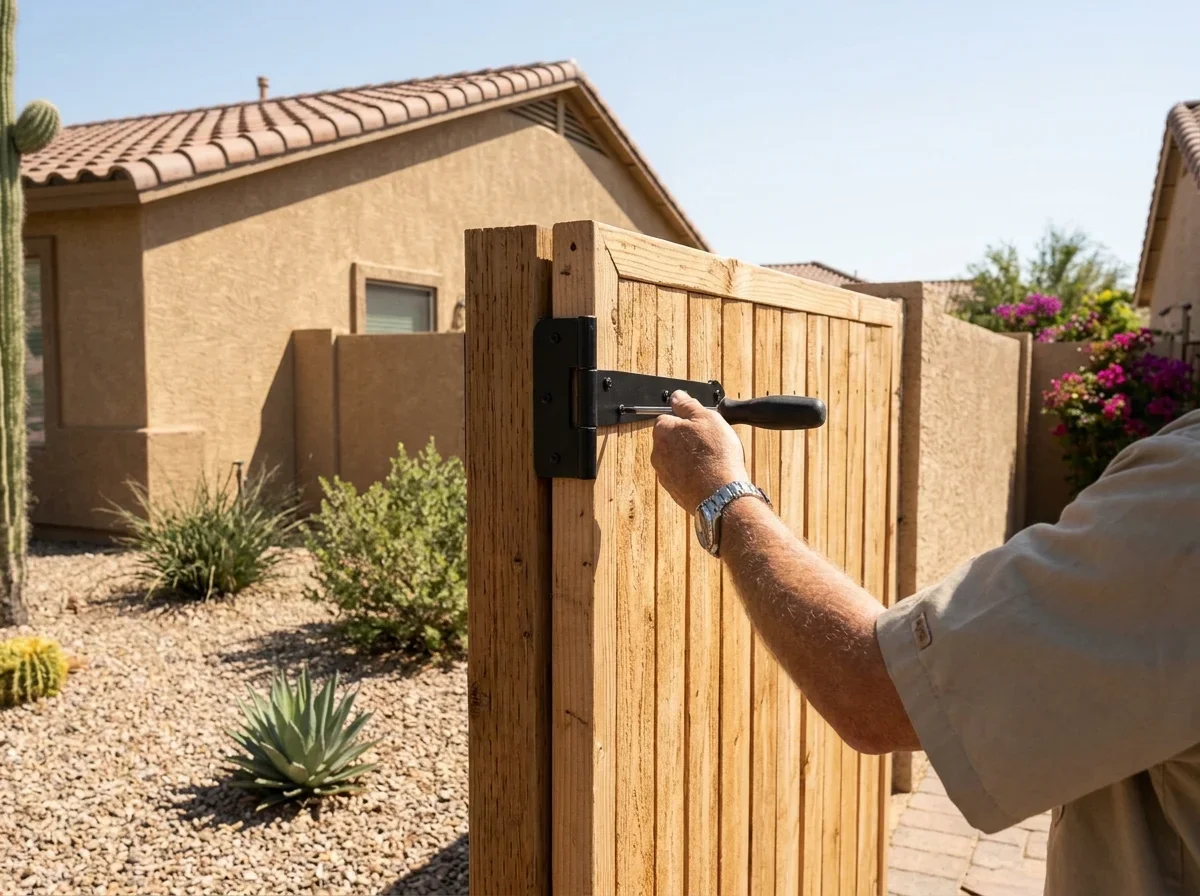
Passing the price test alone is not enough.
How the dollar limit counts labor and materials
The limit applies to the aggregate contract price of the whole project, and the statute counts "labor, materials and all other items."[1] A handyman's labor charge is only one part of the total.
Say a fence repair has labor and materials that together reach $1,000 or more. It is over the limit even if the labor line looks small.
The statute also says "one or more contracts," so one project cannot be broken into several small invoices to stay under the cap.[3] The same goes for a job that starts small and grows through add-ons. Once the project total reaches $1,000, the exemption no longer applies.
Ask for a written estimate that covers the entire project, including materials and any change-order process. If the statute does not clearly settle a question, such as who supplies the materials, confirm it with the Registrar of Contractors before the work starts.
Work the exemption never covers
Some work is outside the exemption whatever it costs. The statute lists these limits in its own words:[1]
- Permit work: "In any case in which the performance of the work requires a local building permit."
- Gas and fuel: "All work done, including installing, maintaining and repairing devices, appliances or equipment, that involves connecting to any supply of natural gas, propane or other petroleum or gaseous fuel."
- Fire safety: "All fire safety and mechanical, electrical and plumbing work that is done in connection with fire safety installation and fire safety maintenance and repair."
The permit limit depends on your city or county, so a job that is exempt in one place may not be in another. Check the Arizona permit rules by city and job or call your local building department before work begins.
| Limit | What the statute excludes |
|---|---|
| Permit work | Any work that requires a local building permit |
| Gas and fuel | Connecting to natural gas, propane or other petroleum or gaseous fuel |
| Fire safety | Fire safety, mechanical, electrical and plumbing work tied to fire safety |
Having no permit does not make a job lawful by default, because the work still has to be casual or minor.[1]
A garage door is a common test case. The question of whether a handyman can fix one is covered on 602garagepros.com.
What a handyman's ad has to say
The exemption is lost for anyone who advertises without disclosing unlicensed status. The statute excludes "a person who uses any form of advertising to the public in which the person's unlicensed status is not disclosed by including the words 'not a licensed contractor' in the advertisement."[1]
A compliant line looks like this: "Small home repairs. Not a licensed contractor."
The exact words matter. A vague phrase like "unlicensed" or "no license" does not match the statute.
If you are hiring, an ad with no such disclosure is a signal to look closer. You can search any contractor by name through the Registrar of Contractors' contractor search[2] and read our guide on how to check a license.
When to hire a licensed contractor
Hire a licensed contractor when any of these is true:
- The total price for the project, labor and materials together, reaches $1,000 or more.[1]
- The work needs a local building permit.[1]
- The work connects to natural gas, propane or other fuel, or is fire safety work.[1]
- The work is more than casual or minor in nature.[1]
Ask the contractor for a license, then confirm it on the ROC search before you sign. The contractor license classes guide explains what each class covers, which helps you match a license to your job.
Decide
Does the exemption apply?
Is the total project price under $1,000?
If No
then: Hire a licensed contractor
If Yes, but it needs a permit, fuel connection or fire safety work
then: Hire a licensed contractor
If Yes, and the work is casual or minor
then: The minor-work exemption may apply
Someone with a handyman-style business who wants bigger jobs needs a contractor license, and that guide is the place to start.
Hiring outside these limits carries its own risks, covered in hiring an unlicensed contractor in Arizona. The statute and the Registrar of Contractors have the final word on any specific job.
Sources
- Arizona Legislature. "A.R.S. 32-1121 (exemptions from contractor licensing)." https://www.azleg.gov/ars/32/01121.htm. Accessed October 21, 2026.
- Arizona Registrar of Contractors. "Arizona ROC contractor search." https://azroc.my.site.com/AZRoc/s/contractor-search. Accessed October 21, 2026.
- Arizona Legislature. "ARS §32-1121." https://www.azleg.gov/viewdocument/?docName=http://www.azleg.gov/ars/32/01121.htm. Accessed October 21, 2026.